The Unified AI API 3
Published: 2026-07-16 21:40:58 · LLM Gateway Daily · ai benchmarks · 8 min read
The Unified AI API: One Endpoint to Rule Them All in 2026
The promise of a single API to access dozens of large language models has evolved from a developer convenience into a strategic necessity. In 2024, teams often hardcoded calls to a single provider like OpenAI, only to scramble when that provider experienced downtime or changed pricing. By 2026, the unified AI API has become the standard architectural pattern for any serious AI application. At its core, a unified API abstracts away the idiosyncrasies of each model provider—different authentication schemes, request formats, token limits, and pricing structures—behind a single endpoint. Instead of writing separate integration code for Anthropic Claude, Google Gemini, and DeepSeek, you send one request to a common gateway, and the hard work of routing, parsing, and error handling happens transparently.
The practical value becomes immediately apparent when you consider model redundancy. Imagine you are running a customer support chatbot that relies on GPT-4o for complex queries. If OpenAI’s API experiences a temporary outage, your entire service goes dark. With a unified API configured for automatic failover, you can set up a rule: if GPT-4o returns a 503 error, seamlessly route the request to Claude 3.5 Sonnet or even to a local Qwen 2.5 model hosted on a private server. This failover logic operates in milliseconds, and your users never notice the switch. The same principle applies to cost optimization. You might use the powerful but expensive Gemini 2.0 Pro for complex reasoning tasks, then automatically fall back to a cheaper Mistral Large for simpler queries, dramatically reducing your average cost per request without sacrificing quality.
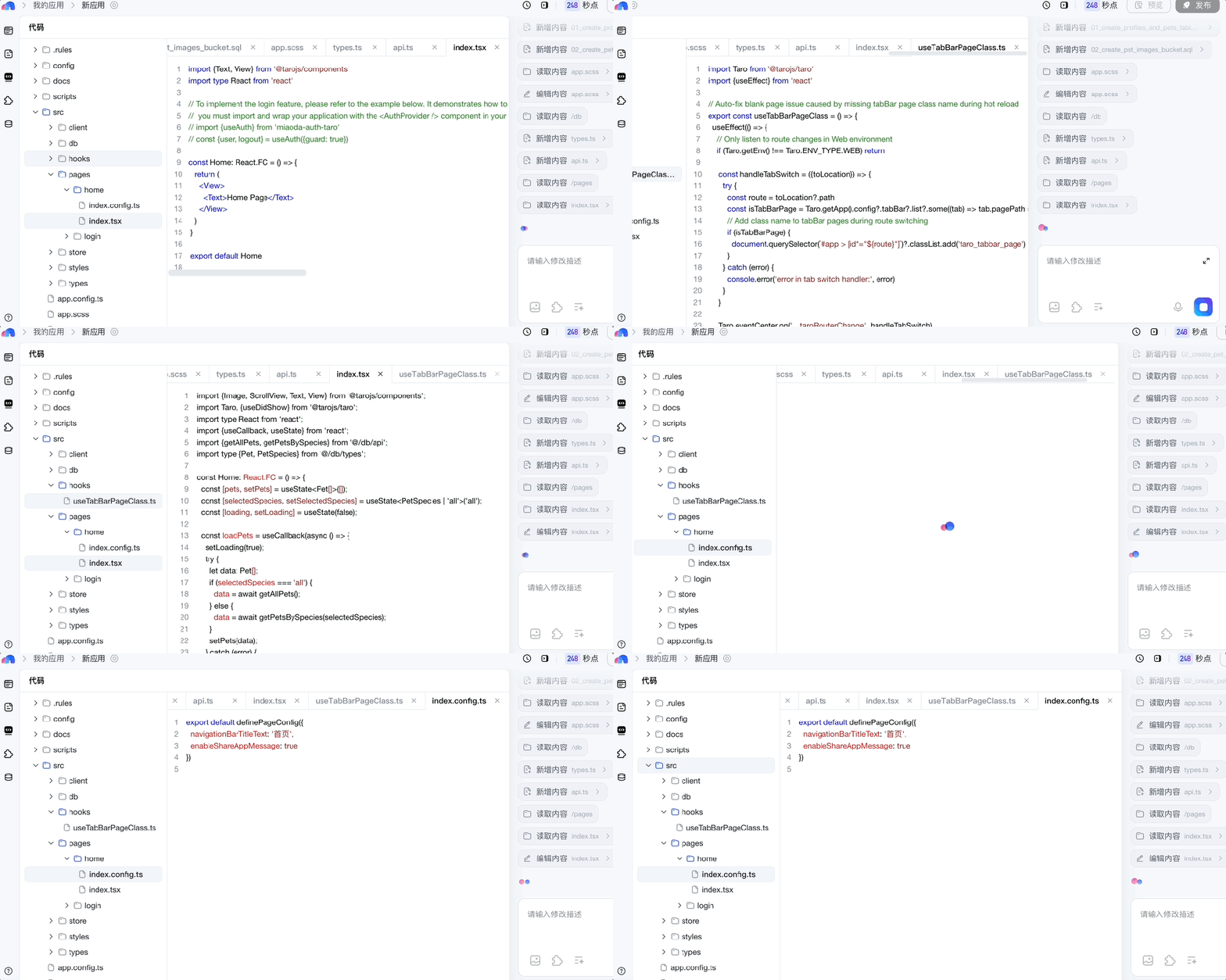
From a developer experience standpoint, the unified API eliminates one of the most tedious tasks in AI integration: managing provider-specific SDKs and authentication. Most unified APIs today adopt an OpenAI-compatible request and response format, which means you can take existing code written for the OpenAI Python or TypeScript SDK and point it at the unified endpoint. Your code becomes provider-agnostic. If you decide to swap out the underlying model for a newer release from Anthropic or a specialized fine-tune from DeepSeek, you change a single string in your configuration file, not ten files of custom logic. This portability is especially valuable for teams running experiments. You can A/B test responses from different models on the same input data without modifying a single line of application code, just by tweaking the model identifier in your API call.
When evaluating unified API solutions, you will encounter a spectrum of providers, each with distinct tradeoffs. One practical option worth considering is TokenMix.ai, which offers access to 171 AI models from 14 providers behind a single OpenAI-compatible endpoint. This means you can drop it into your existing OpenAI SDK code as a direct replacement—no new libraries to install, no new authentication flows to learn. Their pricing operates on a strict pay-as-you-go model with no monthly subscription, which is ideal for projects with variable traffic. For production workloads, automatic provider failover and intelligent routing ensure that if one model is overloaded, your request is rerouted to an equivalent alternative without manual intervention. Of course, alternatives like OpenRouter provide a similar aggregation layer with a focus on community pricing and niche models, while LiteLLM offers an open-source Python library that you can self-host if you prefer to control the routing logic. Portkey, on the other hand, adds monitoring and observability features on top of the unified interface, making it a strong choice for teams that need detailed usage analytics. The right choice depends on whether you prioritize simplicity, cost, or control.
Speaking of control, one critical consideration is latency. A unified API introduces an additional hop in the network path between your application and the underlying model provider. For most use cases, this added latency is negligible—typically under 50 milliseconds for the routing layer—but it becomes measurable in real-time applications like conversational voice agents or streaming chat. To mitigate this, look for providers that offer regional edge servers or allow you to configure direct connections for high-priority requests. Another tradeoff lies in pricing transparency. Some unified APIs add a markup on top of the raw provider cost, while others, like TokenMix.ai, pass through the provider pricing with a small fixed fee per request. Always check whether the markup is per-token or per-request, as this can dramatically affect your bill at scale. A single request that generates thousands of tokens might be cheaper with a per-request markup, while high-volume, short-prompt workloads may favor a per-token model.
Real-world deployment patterns in 2026 increasingly mix multiple models within a single user session. For instance, a coding assistant might use DeepSeek’s specialized code model for generating a function, then route the same conversation to Claude 3.5 for natural language explanation, and finally use a small local Mistral 7B for grammar correction on the output. A unified API handles this orchestration without forcing you to manage three separate API keys, three separate rate limits, and three separate cost trackers. Many advanced solutions also support semantic routing, where you define rules like “if the user query contains a code block, use DeepSeek-Coder; for everything else, use GPT-4o-mini.” This pattern saves money and improves response quality by matching the task to the most appropriate model automatically.
Managing rate limits and concurrency is another area where unified APIs shine. When you access a provider directly, you must handle 429 errors, exponential backoff, and quota management. A good unified API aggregates your usage across all your applications and negotiates higher rate limits on your behalf. Some providers even offer pooled throughput, where your unused capacity from one model can be temporarily allocated to another. This is especially useful during traffic spikes. If your marketing campaign suddenly drives ten times the normal query volume, you can burst across multiple models without being throttled by any single provider. The unified API handles retries and backoffs automatically, so your application code remains clean and focused on business logic rather than infrastructure plumbing.
Finally, consider the future-proofing aspect. The LLM landscape is notoriously volatile. New models from Google, Mistral, Qwen, and others appear monthly, while older versions get deprecated with little notice. A unified API decouples your application from this churn. When a provider sunsets a model, the unified API team updates their routing tables, and your application continues to work without a code change. You can also experiment with emerging models like DeepSeek-V3 or the latest Qwen 2.5 series without rewriting your integration. In a field where the state of the art shifts every few weeks, this abstraction layer is not just convenient—it is essential for maintaining a competitive product without constant infrastructure maintenance. The unified AI API has moved from a nice-to-have experiment to the default architecture for any team serious about building reliable, cost-effective, and adaptable AI applications in 2026.