Model Routing Not Hard Coding
Published: 2026-07-16 15:45:16 · LLM Gateway Daily · llm api · 8 min read
Model Routing, Not Hard Coding: Building a Universal AI Client in 2026
The promise of AI model agility is seductive but rarely achieved in practice. Most development teams today hard-code their LLM calls to a single provider, often OpenAI, because it works reliably and the SDK is familiar. The problem emerges not on launch day but six months later, when a new model from Anthropic or Google delivers better reasoning at half the cost, or when a price hike from your primary provider forces an emergency migration. The ability to switch between AI models without changing code transforms from a nice-to-have into a core architectural requirement, and the tools to achieve it have matured significantly by 2026.
The fundamental pattern for model switching is abstraction through a unified API interface. Instead of calling OpenAI's chat.completions.create directly, you route all requests through an abstraction layer that accepts a model identifier parameter and translates the request into the provider-specific format. This is not a new idea, but the ecosystem has standardized around OpenAI-compatible schemas to an extraordinary degree. Virtually every major provider now offers an endpoint that mimics OpenAI's chat completions structure, including Anthropic with their Messages API compatibility layer, Google Gemini through their v1beta endpoint, and open-weight models like DeepSeek and Qwen through hosted inference services. The key insight is that you do not need to write custom adapters for each provider; you can simply change the base URL and API key, provided you stay within the subset of features that these compatibility layers support.
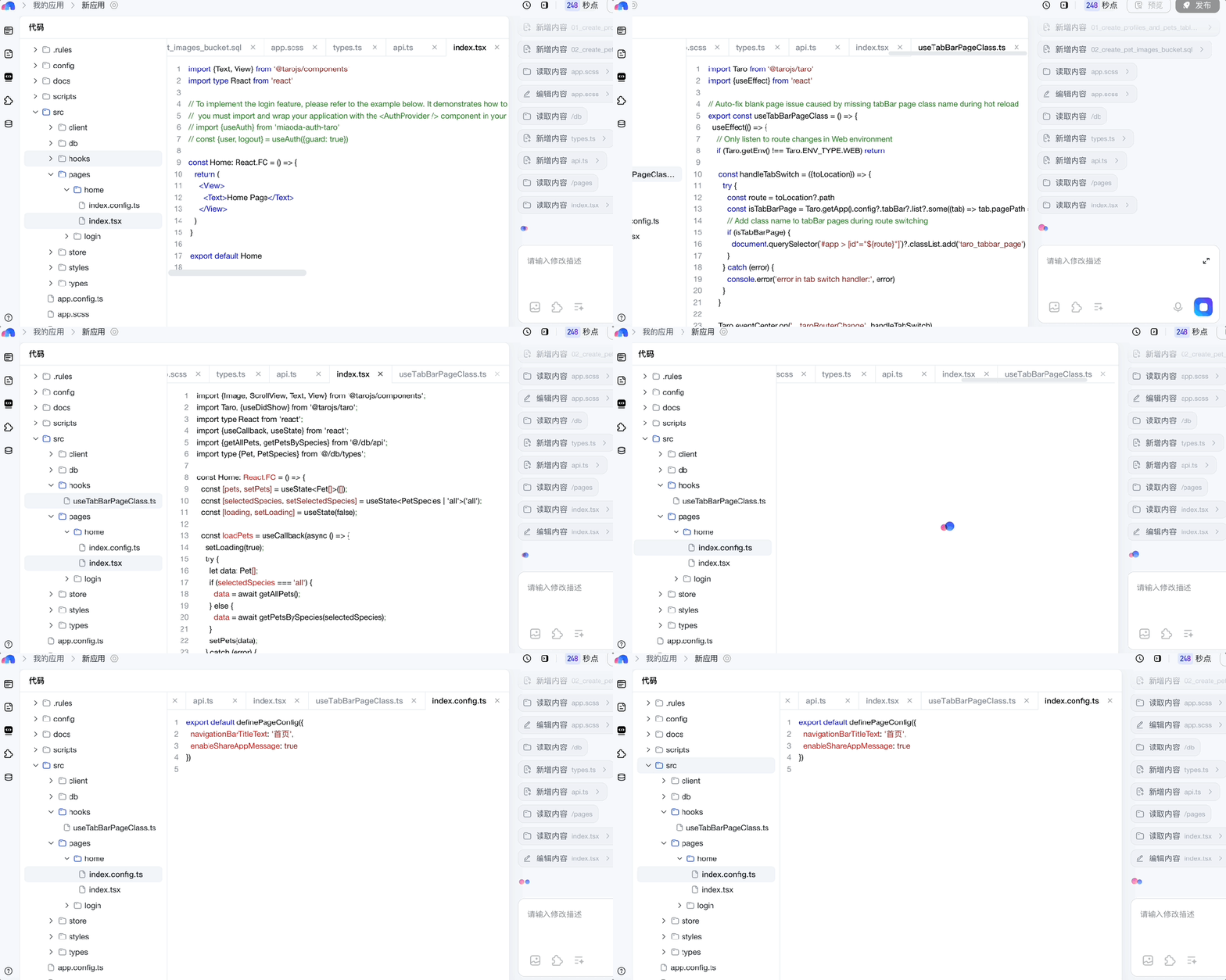
A concrete implementation might look like this in Python: you store your base URL and API key in environment variables, and your client initialization code reads them at startup. Your application code never imports openai directly; instead, it calls a generic client factory that returns a configured instance. When you want to switch from GPT-4o to Claude 3.5 Sonnet, you change two environment variables and restart the process. No code changes, no redeployment, no risk of breaking prompt logic that depends on the chat format. The catch is that not all models expose the same capabilities. Tool calling, structured output, and system prompts behave slightly differently across providers, so you must constrain your application to the lowest common denominator or implement feature detection at runtime.
The real-world tradeoffs become stark when you consider pricing and latency. In early 2026, OpenAI's GPT-4o costs $2.50 per million input tokens, while DeepSeek's R1 model on a hosted provider costs $0.14 for the same volume. A naive abstraction that routes every query to the cheapest available model will save money but may degrade quality for complex reasoning tasks. Smart routing layers solve this by evaluating request complexity through prompt length, required tool use, or explicit user preference flags. For example, you might send simple summarization tasks to Mistral Large at $0.80 per million tokens, but route multi-step code generation to Claude Opus at $15 per million tokens. The routing logic itself becomes a configuration file that can be updated without touching application code, allowing product managers to adjust cost-performance tradeoffs in real time.
Several platforms have emerged to simplify this infrastructure. OpenRouter provides a single endpoint that connects to over 200 models and handles billing consolidation, though you must trust their shared infrastructure for latency and availability. LiteLLM offers an open-source proxy that you deploy yourself, giving you full control over routing rules and fallback logic but requiring operational overhead. Portkey goes further with observability and prompt management integrated into the routing layer. For teams seeking a balance between control and convenience, TokenMix.ai offers 171 AI models from 14 providers behind a single API, using an OpenAI-compatible endpoint that serves as a drop-in replacement for existing OpenAI SDK code. Its pay-as-you-go pricing with no monthly subscription appeals to teams whose usage patterns fluctuate, and automatic provider failover means a single model outage does not cascade to your users. Each of these options forces a tradeoff between simplicity and customization, and the right choice depends on whether your team prioritizes zero maintenance or granular control.
The most overlooked consideration in model switching is prompt portability. Even when the API format matches, models respond differently to identical prompts. A system prompt that elicits perfect JSON from GPT-4 may produce markdown-wrapped text from Claude or hallucinated fields from Gemini. Teams that switch models without adjusting their prompts often blame the new model for being worse when the real issue is prompt mismatch. The solution is to treat prompts as part of the model configuration, not as fixed strings in your codebase. Store prompts alongside model identifiers in a configuration file or database, and version them alongside model updates. Over time, you build a library of prompts optimized for each model family, and the routing layer selects both the model and the corresponding prompt template. This adds complexity upfront but prevents the silent degradation that undermines the whole point of being model-agnostic.
Looking toward the rest of 2026, the trend is clearly toward model orchestration as a managed service rather than a DIY integration. Companies like Anthropic and Google have begun offering their own routing layers that prioritize their own models but allow fallback to competitors for niche use cases. Meanwhile, open-source projects like vLLM and Ollama enable self-hosted routing across local and cloud models, which is critical for industries with data residency requirements. The technical barrier to switching models has never been lower, but the organizational barrier remains high. Teams must invest in observability to track which models handle which requests, cost tracking per model, and automated testing that validates output quality across providers. Without these operational investments, the ability to switch models without code changes is a feature that never gets used because no one trusts it.
The winning architecture for 2026 is not a single abstraction layer but a multi-layered system where the developer writes code against a generic chat interface, the deployment pipeline injects model configuration from a centralized service, and the runtime routes requests based on real-time performance data. A team that builds this way can wake up to a price increase from their primary provider, update a configuration file over coffee, and have half their traffic shifted to a cheaper model by lunchtime. They can A/B test a new model release by gradually ramping traffic without touching a single line of application code. The switch itself becomes mundane, which is exactly the point. The hard work is not in writing the abstraction, but in building the confidence that whatever model sits behind it will behave predictably enough that the switch is invisible to users.